
ES2026 adds seven standard library features to JavaScript and no new syntax. Ecma International approved ECMAScript 2026, formally the seventeenth edition of ECMA-262, on June 30, 2026, at its General Assembly in Geneva.
Several lists online still say this edition brings the Temporal date API and the using keyword. Those lists place both features a year early, though they already run on Node 26. The edition a feature belongs to and whether your runtime has it are two separate facts. Even among the seven new features, six run on Node 26 as they are, and Math.sumPrecise() waits behind a flag.
Free Bonus: What's New in JavaScript (ES2026) Cheat Sheet
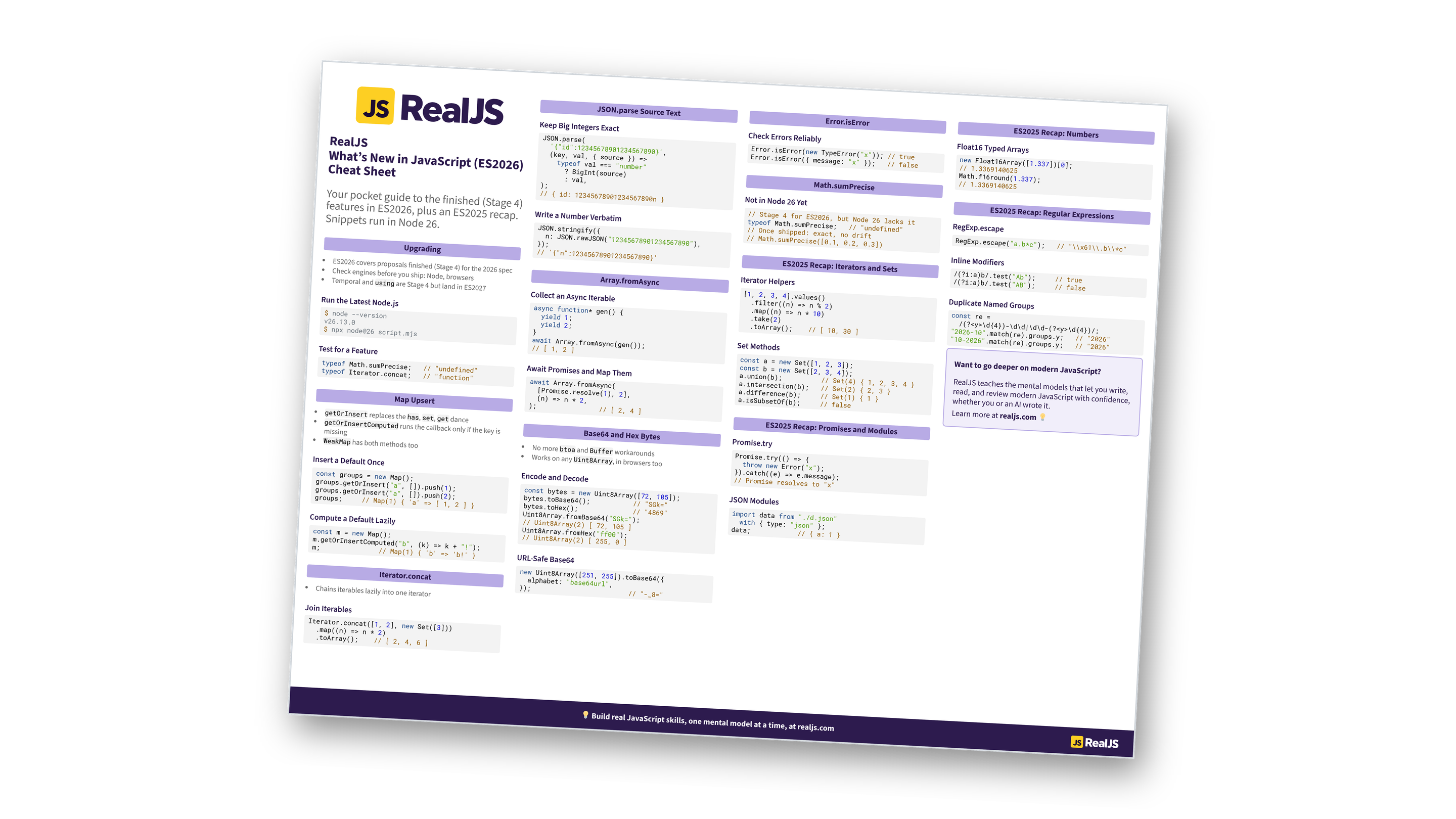
What's new in JavaScript ES2026, with the features you can use today, in one printable reference.
Get the Free Cheat Sheet »What’s in ES2026, and What Isn’t
TC39, the committee that writes the standard, tags exactly seven finished proposals for 2026, and all seven are in the published spec. They fall into three groups:
- Data handling:
Uint8Arrayto and from base64 and hex, and access to the source text inJSON.parse() - Less boilerplate:
Map.prototype.getOrInsert(),Iterator.concat(), andArray.fromAsync() - Fewer silent bugs:
Error.isError()andMath.sumPrecise()
Each feature extends an object you already use, so your build tools don’t need an update to parse code that uses it.
The lists that get the edition wrong tend to add two bigger names. The summary of a dev.to post from April 2026 puts it this way:
ES2026 ships the Temporal API, explicit resource management with using and await using, Error.isError(), and Array.fromAsync.
W3Schools’ JavaScript versions page also files using and await using under ECMAScript 2026. Both sources put them in the wrong edition. Temporal and using are slated for ES2027. TC39’s list tags both proposals for 2027, and the new spec has no Temporal object and no Symbol.dispose.
RegExp.escape() isn’t one of the seven either. It belongs to ES2025, the edition before.
A later edition doesn’t mean you have to wait, though. This short program uses both Temporal and using:
const due = Temporal.PlainDate.from("2026-11-21").add({ days: 10 });
console.log(due.toString());

{
  using lock = { [Symbol.dispose]() { console.log("released"); } };
  console.log("working");
}
Node 26.13.1 prints this, with no flag:
2026-12-01
working
released
Notice that released prints after working, because using calls [Symbol.dispose]() the moment the block ends.
As of November 21, 2026, MDN’s browser data lists Temporal support in Chrome 144 and Firefox 139, and using support in Chrome 134 and Firefox 141. Safari is behind, with both features only in the Safari 27.3 beta, not in the current 27.2 release. In Node, using has worked since 24.0.0, and Temporal since 26.0.0.
Base64 and Exact JSON Numbers
These two features fix quiet trouble with data that comes from somewhere else, such as a file upload or an API response. No base64 method for bytes worked in every runtime, and JSON.parse() could round off a long ID without telling you.