Backend Web Development
The backend is everything a web app does on the server: handling HTTP requests, serving APIs, talking to databases, and checking who’s allowed to do what. These tutorials teach backend development in JavaScript, from your first HTTP server to the APIs, authentication, and deployment that real apps need.
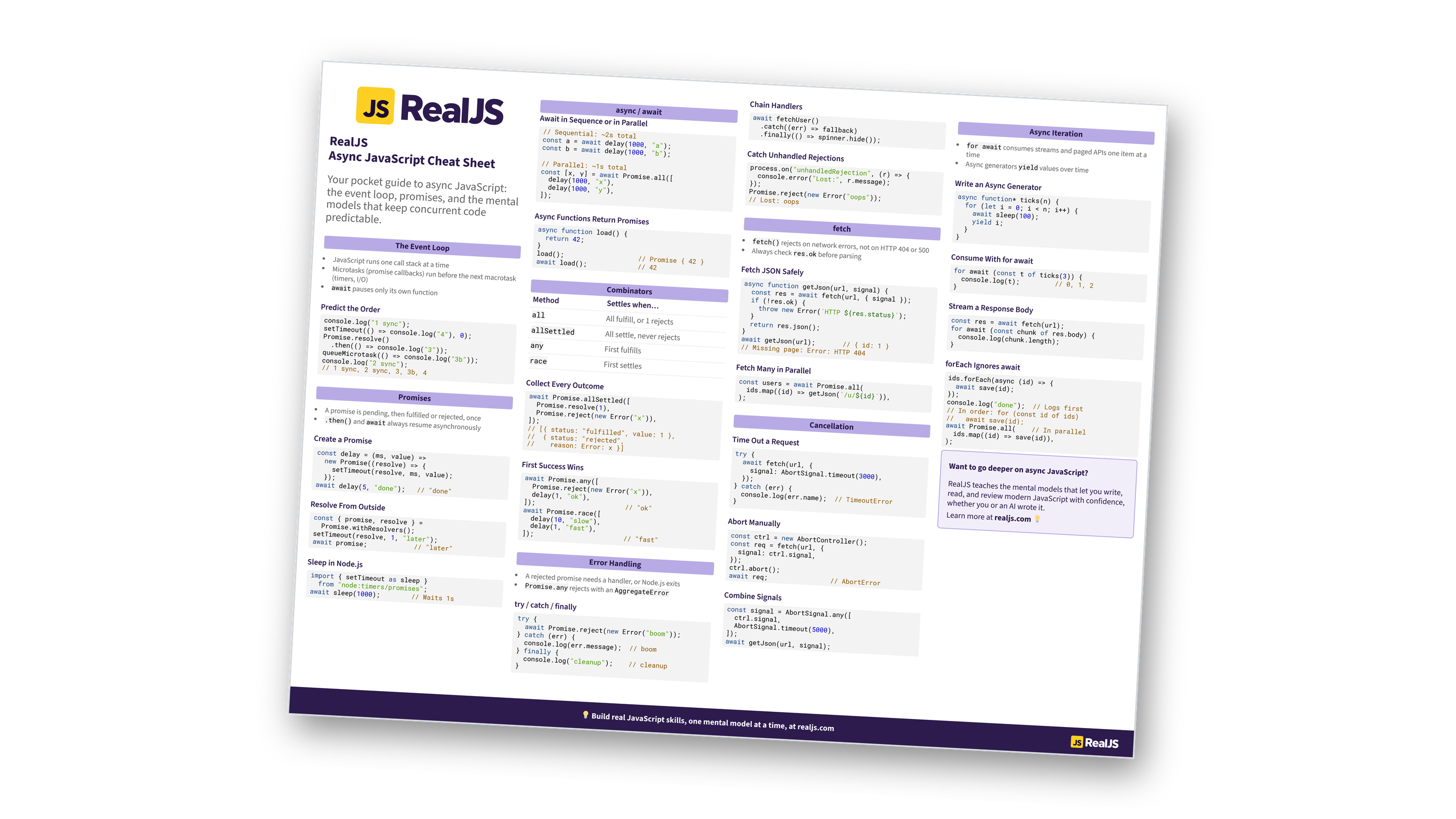
Free Bonus: Download the Async JavaScript Cheat Sheet PDF and keep the essentials at hand.
Server code is where small mistakes turn into security holes and outages, so it pays to understand what each line does, whether you wrote it or an AI assistant did. You’ll learn how requests flow through a server, how to design clean APIs, how to store data safely, and how to run your app in production with serverless and edge functions.
Yes. Runtimes such as Node run JavaScript on the server, where it powers web servers, APIs, and real-time services. Using one language on both the frontend and backend lets you share code and skills across the whole app.
A REST API exposes your app’s data as resources at URLs, such as /users/42, and uses HTTP methods like GET, POST, and DELETE to read and change them. Clients, such as a frontend or a mobile app, exchange data with it as JSON.
It depends on your data. A relational database such as PostgreSQL or SQLite is a strong default for structured data with relationships. A document database fits data that varies in shape. Start with the simplest option that fits, and learn the queries your app needs.
The frontend runs in the user’s browser and handles what they see and click. The backend runs on a server and handles data, business rules, and security. The two talk over HTTP, usually through an API.
Serverless platforms run your functions on demand, so you don’t manage servers yourself. You deploy small handlers that respond to requests or events, and the platform scales them up and down for you.