ECMAScript
ECMAScript is the standardized specification of the JavaScript language, published by Ecma International as ECMA-262, which defines the syntax, semantics, and built-in objects that every JavaScript engine implements.
The language was created by Brendan Eich at Netscape, and Ecma adopted the first edition of the standard in June 1997. In everyday use, “JavaScript” names the language that programs are written in, and “ECMAScript” names the standard that defines it. Engines such as V8 implement the standard, so the language behaves consistently across the engines that conform to it.
The specification covers the grammar, operators, modules, and built-ins such as Array and Promise. It has no input or output of its own. A runtime adds the host APIs that ECMAScript doesn’t define, such as the DOM in browsers and file access in Node.js:
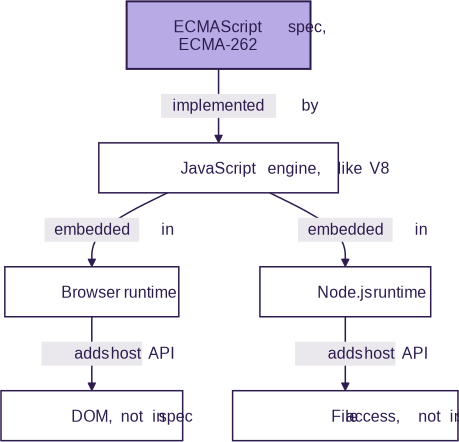
The sixth edition, ES2015, is often called ES6. It added classes, modules, block scoping, iterators, generators, and promises. Since ES2016, the TC39 committee has published a new edition every year and named it after the year. Each edition collects the proposals that reached Stage 4, the final stage of the TC39 process, since the previous one.
ES2026, the seventeenth edition, is the current standard. TC39 keeps a living draft of the next edition, ES2027, which already includes the features that reached Stage 4 after ES2026 was finalized. Developers use edition names to date features, as in “Object.groupBy() arrived in ES2024,” and build tools accept an edition as the target for the code they output.
Related Resources
Course
From Python Packages to JavaScript Modules: ESM and CommonJS
Organize larger JavaScript programs with ES modules, shared state, dynamic imports, and CommonJS while porting a Python heating digest.
Have a question about this? Mentor AI can show you examples, compare related terms, and point you to tutorials.
Ask Mentor AI

By Leodanis Pozo Ramos • Updated Nov. 20, 2026
