Proxy
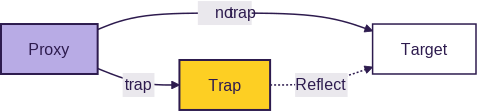
The Proxy global object wraps another object and lets a handler intercept the basic operations performed on it, such as reading, writing, or deleting a property. Each intercepting function on the handler is called a trap. In this example, a get trap returns a placeholder for a missing translation instead of undefined:
> const labels = new Proxy(
…   { save: "Save" },
…   { get: (target, key) => target[key] ?? `[missing: ${String(key)}]` },
… );
undefined

> labels.save
'Save'
> labels.cancel
'[missing: cancel]'
Any operation without a trap on the handler passes straight through to the target. An empty handler therefore gives a proxy that forwards every operation to its target. Since ES2015, Proxy has shipped with the Reflect namespace, which mirrors each trap so a trap can forward an operation to the target:
Syntax
The Proxy constructor takes the object to wrap and a handler object:
new Proxy(<target>, <handler>)
| Parameter | Description |
|---|---|
target |
The object to wrap. It can be any object, including an array, a function, or another proxy |
handler |
An object whose methods are the traps. Operations it doesn’t define fall through to target |
The constructor returns a new proxy object. It must be called with new, and calling Proxy() without it throws a TypeError. Proxy has no prototype property, so proxies have no instance methods of their own. A proxy reports its target’s prototype unless a getPrototypeOf() trap says otherwise.
Key Static Methods and Properties
| Member | Kind | Description |
|---|---|---|
Proxy.revocable() |
Static method | Returns an object holding a new proxy and a revoke() function that permanently switches the proxy off |
Key Handler Traps
| Member | Kind | Description |
|---|---|---|
get() |
Trap | Intercepts reading a property |
set() |
Trap | Intercepts assigning a property and returns true on success |
has() |
Trap | Intercepts the in operator |
deleteProperty() |
Trap | Intercepts the delete operator |
ownKeys() |
Trap | Intercepts listing own keys, as in Object.keys() and Reflect.ownKeys() |
defineProperty(), getOwnPropertyDescriptor() |
Trap | Intercept defining a property and reading its descriptor |
getPrototypeOf(), setPrototypeOf() |
Trap | Intercept reading and changing the prototype |
isExtensible(), preventExtensions() |
Trap | Intercept checking and turning off extensibility |
apply() |
Trap | Intercepts calling the target, which must be a function |
construct() |
Trap | Intercepts calling the target with new |
Every trap receives the target as its first argument. Each one matches a Reflect method with the same name and arguments, so a trap can add its own logic and then forward the operation with a call such as Reflect.set(target, key, value).
Examples
An inventory object must only ever hold whole, non-negative stock counts. A set trap returns false to reject a bad value, and strict-mode code, which includes every module, turns that false into a TypeError:
inventory.mjs
const stock = new Proxy(
  {},
  {
    set(target, key, value) {
      if (!Number.isInteger(value) || value < 0) {
        return false;
      }
      return Reflect.set(target, key, value);
    },
  },
);

stock.mugs = 12;
console.log(`Mugs: ${stock.mugs}`);

try {
  stock.tees = -3;
} catch (error) {
  console.log(`Rejected: ${error.message}`);
}

console.log(`Tees: ${stock.tees}`);
Running the module shows the valid count stored and the negative one refused:
$ node inventory.mjs
Mugs: 12
Rejected: 'set' on proxy: trap returned falsish for property 'tees'
Tees: undefined
In sloppy-mode code, the same rejected assignment fails silently instead of throwing.
An app hands session data to a third-party plugin and wants to cut off its access when the plugin unloads. Proxy.revocable() returns the proxy along with a revoke() function, and after that call every trapped operation on the proxy throws:
> const session = { userId: 42 };
undefined
> const { proxy: pluginView, revoke } = Proxy.revocable(session, {});
undefined

> pluginView.userId
42

> revoke();
undefined
> pluginView.userId
Uncaught TypeError: Cannot perform 'get' on a proxy that has been revoked
> typeof pluginView
'object'
The typeof operator still works because it doesn’t trigger a trap.
Common Gotchas
A proxy is a separate object with its own identity, so it never equals its target, even though writes through it land on the target:
> const config = { debug: false };
undefined
> const watched = new Proxy(config, {});
undefined

> watched === config
false
> watched.debug = true;
true
> config.debug
true
Built-in objects that keep their data in internal slots, such as Map, Set, and Date, don’t work through a plain proxy. Their methods run with the proxy as this, and the proxy doesn’t have those slots:
> const tags = new Proxy(new Map([["js", 3]]), {});
undefined

> tags.size
Uncaught TypeError: Method get Map.prototype.size called on incompatible receiver #<Map>
    at get size (<anonymous>)
The same applies to private class fields. A get trap that reads properties with the target as the receiver and binds methods to the target works around it:
> const tags = new Proxy(new Map([["js", 3]]), {
…   get(target, key) {
…     const value = Reflect.get(target, key, target);
…     return typeof value === "function" ? value.bind(target) : value;
…   },
… });
undefined

> tags.size
1
> tags.get("js")
3
A trap also can’t report a value that contradicts the target’s fixed properties. When a property is non-writable and non-configurable on the target, as on a frozen object, a get trap that returns a different value throws a TypeError.
Related Resources

Course
Records With Objects
Describe one thing with named fields in a JavaScript object, keep a list of those records, and write functions that select, find by id and update them. Build a board-game shelf helper, then a small records program of your own.
Have a question about this? Mentor AI can show you examples, compare related terms, and point you to tutorials.
Ask Mentor AI

By Leodanis Pozo Ramos • Updated Nov. 13, 2026
