JavaScript for Advanced Pythonistas
Learning Path ⋅ Skills: JavaScript Type System, Prototypes, Iterators, Generators, Event Loop, Metaprogramming

This path is for experienced Python programmers who want to understand JavaScript as deeply as they understand Python. You’ll move quickly through fast-track versions of the foundation and intermediate courses, from types and equality to classes, testing, and asynchronous code, then spend your time on how JavaScript works underneath.
The advanced courses start with JavaScript’s type system at runtime, the object model with property descriptors and freezing, how this is bound, decorators, and prototypes. Then you’ll write iterators and generators, work with Unicode and bytes, and see how the event loop and workers run your code. The path ends with metaprogramming and a look at what a JavaScript engine does with your programs.
Each course starts from the Python you already know and focuses on where JavaScript differs.
You’ll practice with exercises and a quiz in every course, and with a project at the end of each one. If you’ve already completed the Beginner or Intermediate path, you can skip the fast-track versions of courses you’ve already taken.
JavaScript for Advanced Pythonistas
Learning Path ⋅ 38 Resources
Is this path right for you? Mentor AI knows what’s in it and can help you decide where to begin.
Ask Mentor AI

Set Up JavaScript and Learn Its Shape
Start with fast-track courses that get JavaScript running on your computer, take you on a quick tour of the language from a Python point of view, and cover the syntax rules that differ from Python’s.

Course
Getting Started With JavaScript for Pythonistas (Fast Track)
Install Node and port a Python setup-check script to JavaScript in this faster version, and learn to run scripts, set up a project, and read JavaScript's errors.
Course
A First Tour of JavaScript for Pythonistas (Fast Track)
Get a quick first look at JavaScript by porting a small Python report, skipping what matches Python and focusing on what JavaScript does differently with names, strings, decisions, loops, functions, arrays, and objects.

Course
JavaScript Syntax for Pythonistas (Fast Track)
Port a web agency's release-note script from Python to JavaScript in this shorter course, and learn how JavaScript's blocks, statements, line breaks, and names differ from Python's.
Pin Down Types and Equality
Next, you’ll compare JavaScript’s variables and types with Python’s, then work through equality, type checks, and the conversions that catch Python programmers out.

Course
JavaScript Variables and Types for Pythonistas (Fast Track)
The shorter version for experienced Pythonistas: port a Python backup check to JavaScript, and learn const, let, typeof, null and undefined, empty values, and ===.

Course
JavaScript Equality and Type Checks for Pythonistas (Fast Track)
Port a weather station's Python readings check to JavaScript while comparing objects, checking types, reading loose equality, and handling NaN with Object.is().
Work Precisely With Numbers
With types in place, you’ll cover JavaScript numbers, then precision, large integers with BigInt, and number formatting.

Course
JavaScript Numbers for Pythonistas (Fast Track)
Port a coffee roastery's batch planner from Python to JavaScript in this faster version for experienced Python programmers, covering division, rounding, text input, and formatting.

Course
JavaScript Number Precision, BigInt, and Formatting for Pythonistas (Fast Track)
Port a coffee roastery's month-end invoice script to JavaScript in this faster version for experienced Python programmers, covering float sums, BigInt, NaN, and formatting.
Handle Text and Regular Expressions
Now you’ll move to text: JavaScript strings first, then regular expressions and text formatting, mapped onto Python’s str methods and re module.

Course
JavaScript Strings for Pythonistas (Fast Track)
Port a payments team's branch-name helper to JavaScript in this faster version, and learn where Python's string habits, from slicing to split() and join(), give the wrong text.

Course
JavaScript Regular Expressions and Text Formatting for Pythonistas (Fast Track)
Port a Python release-notes script to JavaScript while aligning text columns, testing regular expressions, extracting named groups, and rewriting matches.
Store and Reshape Data
Next come collections. You’ll compare arrays with Python lists and plain objects with dicts, then copy, freeze, and sort arrays without the surprises that catch Python programmers.
Course
JavaScript Arrays for Pythonistas (Fast Track)
Port a Python pager-rota script to JavaScript while building arrays, adding and removing at the ends, taking copies, editing in place with splice, searching, and sorting numbers.
Course
From Dicts to JavaScript Objects for Pythonistas (Fast Track)
Port a Python label script to JavaScript while writing object literals, filling defaults with ??, reaching into nested data with ?., removing duplicates with a Set, and reading and writing JSON.
Course
Copying, Freezing, and Sorting JavaScript Arrays for Pythonistas (Fast Track)
The shorter version for experienced Pythonistas: port a league table script to JavaScript, and learn to copy, deep-copy, freeze, and sort arrays and records safely.
Use Map, Set, and Smarter Conditionals
Building on objects, you’ll pick the right collection with Map and Set, then write conditions and port Python’s default values and match statements.

Course
JavaScript Map and Set for Pythonistas (Fast Track)
Port a community garden's season report to JavaScript in this faster version, and learn when to use a Map, a Set, or an object, and how to count, group, and compare without Counter.

Course
JavaScript Conditionals for Pythonistas (Fast Track)
Port a Python race-day script to JavaScript while writing else if chains, choosing values with the conditional operator, combining conditions with && and ||, checking ranges, and matching values with switch.

Course
Porting Python's Defaults and match Statements to JavaScript (Fast Track)
Port a community center's booking confirmations to JavaScript in this shorter course, and learn to choose between || and ??, fill in missing values, port match statements, and call functions safely.
Loop, Write Functions, and Transform Arrays
With data and decisions covered, you’ll write loops and functions in JavaScript, then replace Python’s comprehensions with array methods.

Course
JavaScript Loops for Pythonistas (Fast Track)
Port a night-bus team's morning report to JavaScript in this faster version for experienced Python programmers, and learn where Python loop habits break, often silently.
Course
JavaScript Functions for Pythonistas (Fast Track)
Port a freelance translator's quote script from Python to JavaScript in this shorter course, and learn how JavaScript functions return results, take defaults and options, and use arrows.

Course
From Comprehensions to JavaScript Array Methods (Fast Track)
The shorter version for experienced Pythonistas: port a race results script to JavaScript, and replace comprehensions and star unpacking with array methods and spread.
Work With Scope, Modules, and Errors
Next, you’ll see how JavaScript scopes names and uses closures, split code into modules and scripts, and read and debug JavaScript errors.

Course
JavaScript Scope, Closures, and Functional Patterns for Pythonistas (Fast Track)
Port a bouldering gym's front-desk script to JavaScript in this faster version, and learn how JavaScript scope and closures work, and how to use rest parameters, callbacks, and timers.

Course
JavaScript Modules and Scripts for Pythonistas (Fast Track)
The shorter version for experienced Pythonistas: port a Python boiler log digest to JavaScript, and learn modules, script arguments, exit codes, and reading and writing files.

Course
JavaScript Errors and Debugging for Pythonistas (Fast Track)
Port a food bank's donation import to JavaScript in this faster version, and learn to catch, throw, and tell apart errors, and check for the bad data JavaScript doesn't throw on.
Look Inside Classes, Types, and Objects
Now you’ll model data with classes, then go below the surface: how JavaScript’s type system works at runtime, and how properties, descriptors, and freezing shape every object.
Course
JavaScript Classes for Pythonistas (Fast Track)
Port a swimming pool's booking module to JavaScript in this faster version for experienced Python programmers, covering constructors, private fields, static, extends, and this.

Course
JavaScript's Type System Under the Hood
Port a museum gallery's temperature display from Python to JavaScript, and learn how JavaScript turns objects into text and numbers, and how to take control of it with Symbol.toPrimitive.

Course
The JavaScript Object Model: Properties, Descriptors, and Freezing
Port a print shop's Python proof card export to JavaScript, and learn to control what an object owns, computes, lists, and lets you change, with descriptors, symbols, and freezing.
Trace this, Errors, and Prototypes
With the object model in view, you’ll follow how this is bound, write decorators and read the call stack, handle errors in depth, and see how prototypes link objects together.

Course
JavaScript's this, Decorators, and the Call Stack for Pythonistas
Port a translation desk's quote pipeline to JavaScript, and learn to keep a method's this, apply decorators as explicit wrappers, build cache keys that work, and trace the call stack.

Course
JavaScript Error Handling in Depth for Pythonistas (Fast Track)
Port Python error handling to JavaScript: define custom errors, preserve causes, report several failures together, and debug an all-or-nothing donation import in this compact course.

Course
JavaScript Prototypes and the Object Model
Port a tool library's kit model from Python to JavaScript, and learn how prototype lookup works, what class syntax guarantees, and how classes join protocols and combine behavior.
Test, Handle Dates, and Write Async Code
Next, you’ll test your code the way you’d use pytest, work with dates, times, and time zones, and write asynchronous code with promises and async functions.

Course
JavaScript Testing for Pythonistas (Fast Track)
Port a ski-hire shop's pytest suite to JavaScript in this shorter course, and learn to test with Node's built-in runner, from assertions and many cases to async tests and mocks.

Course
JavaScript Dates and Times for Pythonistas (Fast Track)
The shorter version for experienced Pythonistas: port a clinic's reminder script to JavaScript, reading older Date code and using Temporal for time zones and durations.

Course
Async JavaScript for Pythonistas (Fast Track)
Port a library's asyncio holds check to JavaScript in this faster version, and learn async functions, the promises behind await, Promise.all(), timeouts, and retries.
Iterate Lazily and Handle Text at a Lower Level
Next, you’ll write iterators and generators, then work with Unicode, bytes, and advanced regular expressions.

Course
JavaScript Iterators and Generators for Pythonistas
Port a weather station's sensor feed from Python to JavaScript, and learn to write iterators and function* generators, chain lazy iterator helpers, and read async feeds with for await...of.
Course
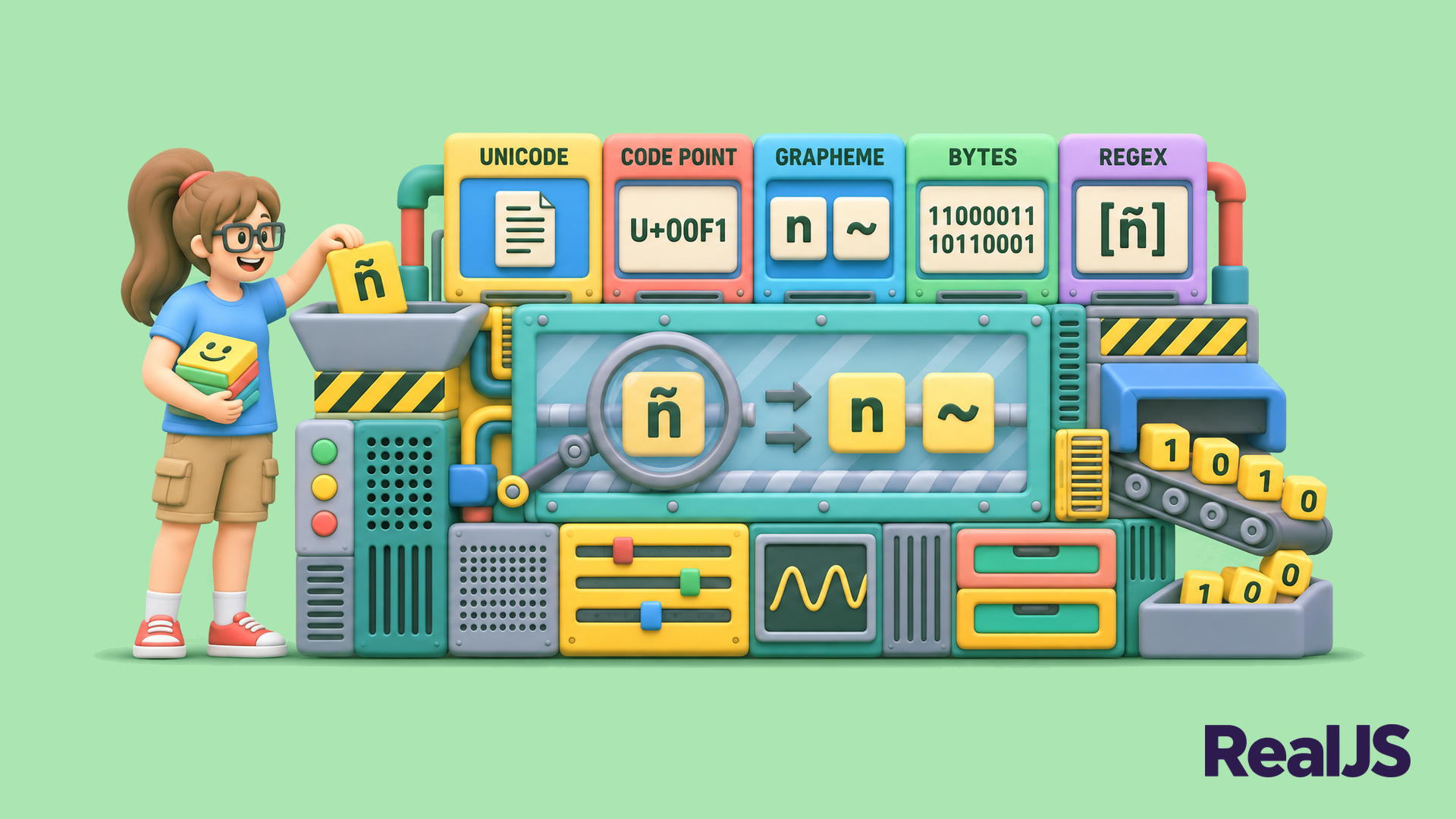
JavaScript Unicode, Bytes, and Advanced Regular Expressions
Port a payments team's Python branch-name helper to JavaScript, and learn code points, normalization, UTF-8 bytes with Uint8Array, and Unicode-aware regular expressions.
Structure Projects and Run Concurrent Code
Now you’ll organize projects with ES modules and CommonJS, clean up resources the way Python’s with statement does, and see how the event loop, concurrency, and workers run your code.

Course
From Python Packages to JavaScript Modules: ESM and CommonJS (Fast Track)
Port a Python heating digest to JavaScript while organizing ES modules behind an entry file, controlling shared module state, loading modules on demand or by name, and using supplied CommonJS files.

Course
From Python's with to JavaScript's using and try/finally (Fast Track)
Port a print shop's job runner to JavaScript in this faster version for experienced Python programmers, covering try/finally, using, await using, and disposable stacks.

Course
The JavaScript Event Loop, Concurrency, and Workers
Build a weather-station dashboard in JavaScript, and learn how the event loop orders timers and promises, how to cancel work with AbortController, and when to move CPU work to a worker.
Change the Language and See How It Runs
Finally, you’ll use JavaScript’s metaprogramming tools, then look at how a JavaScript engine runs your code under the hood.

Course
JavaScript Metaprogramming for Pythonistas
Build a settings audit in JavaScript from Python's attribute hooks, and learn proxies, traps, Reflect, well-known symbols, tagged templates, and when a factory beats a metaclass.

Course
JavaScript Under the Hood for Pythonistas
Investigate why a game server's match-log processor slows down, and learn to profile JavaScript fairly, explain what V8 learns, trace what keeps objects alive, and read the specification.
Test Your Knowledge
You’ve made it through the whole path! In the wrap-up quiz below, you’ll revisit equality and numbers, objects and defaults, scope, the type system and object model, this and decorators, prototypes, async code, iterators and generators, Unicode and bytes, resource cleanup, the event loop, metaprogramming, and what happens under the hood. Use it to spot any topics that still feel rusty.
Interactive Quiz
JavaScript for Advanced Pythonistas
Check what you've learned about JavaScript as an advanced Pythonista, from prototypes and this to generators, the event loop, and proxies.
Congratulations on completing this learning path! You can now reason about JavaScript’s types, objects, and prototypes, write iterators, generators, and concurrent code, use metaprogramming tools, and explain how the engine runs your programs, connecting each idea to what you know from Python.
You might also be interested in these related learning paths:
Got feedback on this learning path?
Looking for real-time conversation? Visit the RealJS Community Chat or join the next “Office Hours” Live Q&A Session. Happy coding!
