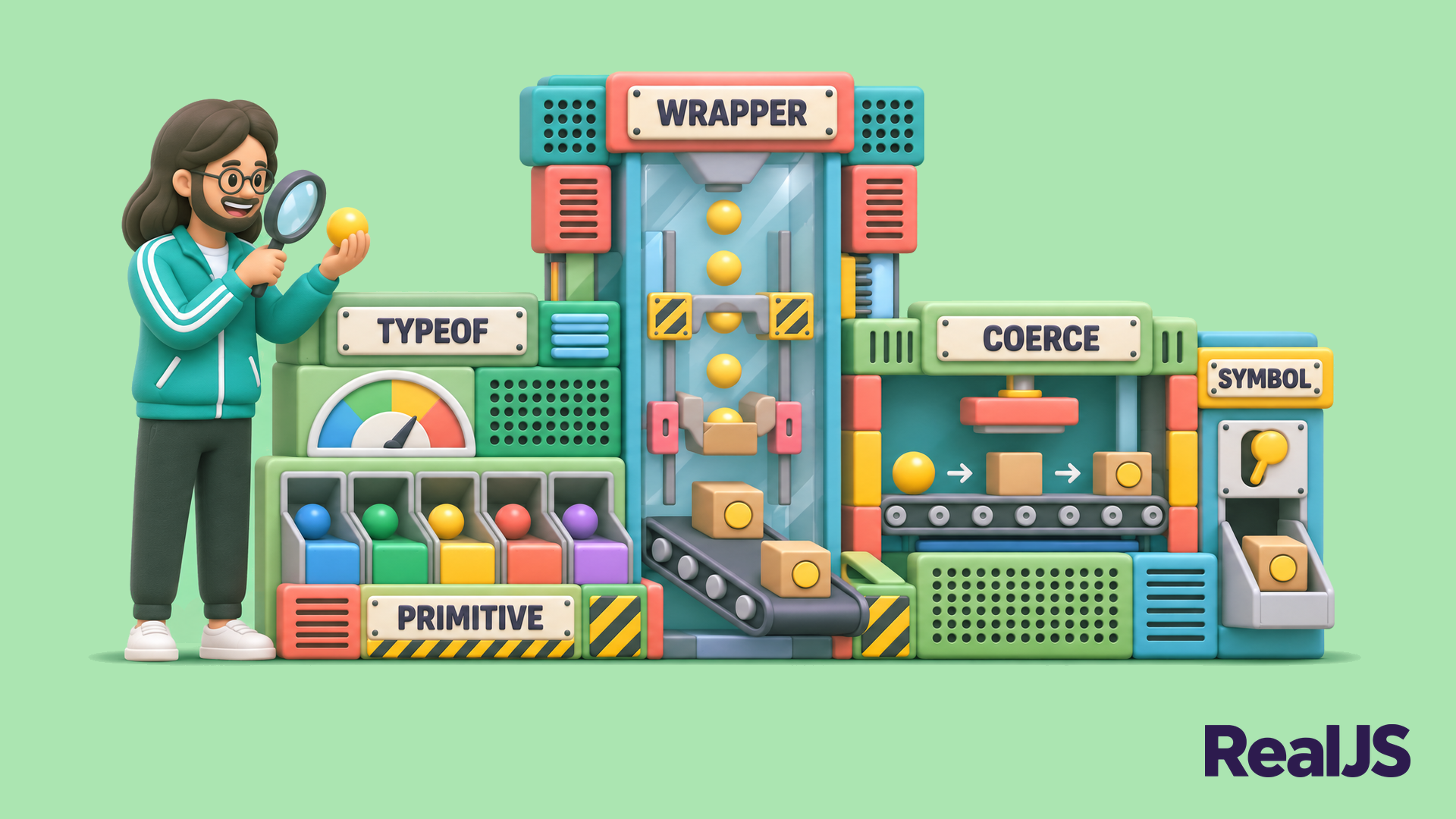

In Python, __str__() decides how an object prints. Port that to a toString() method, log a reading with console.log(reading), and you get Reading { celsius: 21 } instead of the 21 C label. Logging, formatting, and arithmetic each turn an object into a value their own way in JavaScript.
In this course, you’ll port a museum gallery’s temperature display, whose Reading class keeps each reading’s number and label apart.
By the end of this course, you’ll be able to:
- Explain where a primitive value’s methods live, such as a string’s
.toUpperCase() - Trace how JavaScript turns an object into text or a number with
valueOf()andtoString() - Read the specification’s conversion steps for a few values
- Handle all three conversion hints with
Symbol.toPrimitive - Port the gallery formatter to JavaScript
You’ll need Python’s data model, where dunder methods such as __str__() and __float__() drive conversions. You’ll also need Node 26 and JavaScript classes with constructor, this, and toString(), plus typeof, ===, and converting with String(), Number(), and Boolean(). The Python examples use Python 3.15.
The course mixes short videos and text lessons with exercises, a project that ports the gallery formatter, and a quiz.
What’s Included:
- 13 Lessons
- Video Subtitles and Full Transcripts
- Translated Subtitles in 8 Languages
- 2 Downloadable Resources
- Interactive Quiz to Check Your Progress
- 4 Hands-On Coding Exercises
- Q&A With JavaScript Experts: Ask a Question
- Certificate of Completion

Downloadable Resources:
Related Learning Paths:
