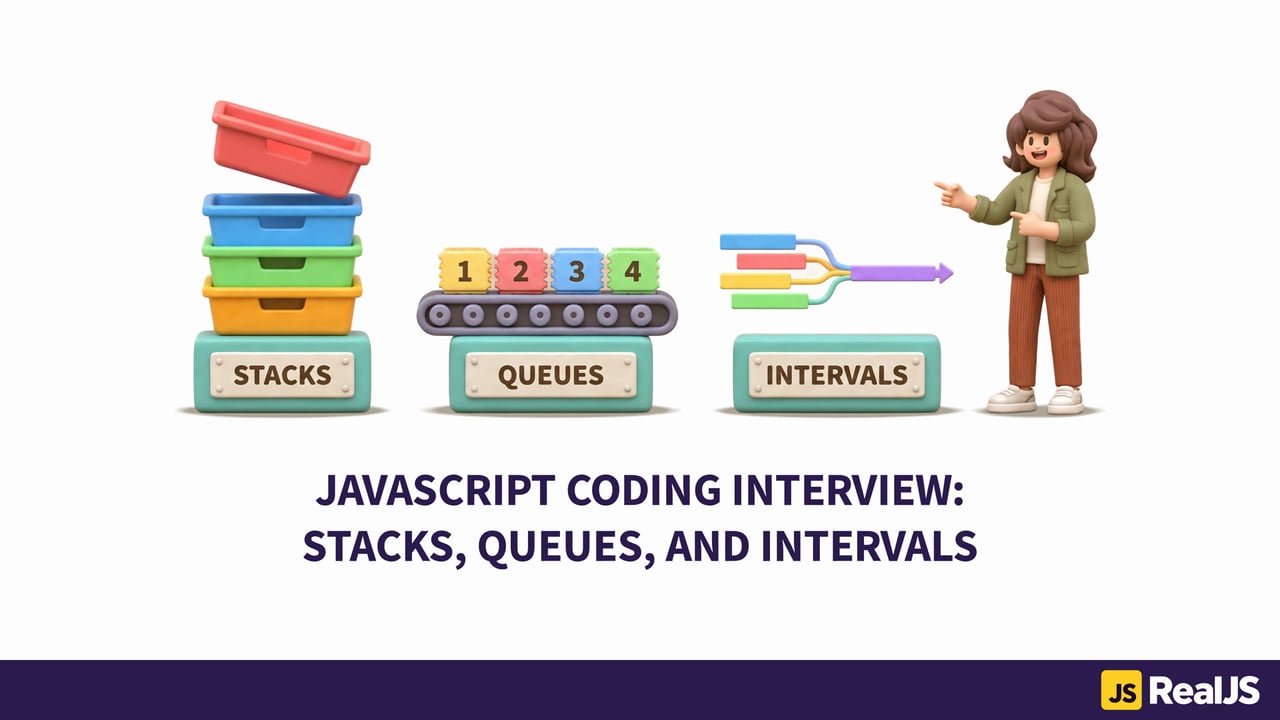

In this course, you’ll practice two patterns for problems where the order of things carries the answer: stacks and queues, which keep unfinished work in the order you’ll need it back, and sorting with intervals, which puts ranges in an order you can sweep through once.
What You’ll Practice
- Stacks: park items that are still waiting for a partner, such as an open bracket, a tag, or a folder, and settle the most recent one first
- Queues: serve or expire items in the order they arrived, such as requests inside a rate-limit window
- Sorting and intervals: order meetings and time blocks with the right comparator, then detect, merge, intersect, or trim overlaps in a single sweep
You’ll also run into JavaScript details that interviewers like to probe. Why does shift() turn a queue into O(n²) work on large arrays? Why does sort() without a comparator put [1015, 1100] before [800, 845]? Why is a comparator that returns true or false broken? And why does sort() reorder the caller’s array while toSorted() doesn’t?
How the Course Works
- Concept lessons introduce each pattern with short examples you can run.
- Exercises run in your browser on Node 26, so there’s nothing to install. Each problem is set in a web-app scenario, from a code editor’s bracket checker to a team calendar. Get a working solution first. Then a bonus test plays the interviewer’s follow-up: does your solution still hold up when the input gets large?
- An AI-code review hands you a plausible schedule sorter with hidden bugs. Finding and fixing them is the skill you need whenever an assistant writes code for you.
- Recaps at the end of each section let Mentor AI look at your attempts and talk through whatever hasn’t clicked yet.
- Mixed Practice ends the course with problems that don’t name their pattern, a quiz on choosing the right one, and a mock interview.
Before You Start
You should be comfortable writing JavaScript functions and working with arrays, objects, and loops. Knowing what O(n), O(n log n), and O(n²) mean helps, and the concept lessons review the costs you’ll need. If you’ve taken the first two courses in this path, you’ve already met the habits this course builds on: get a correct solution first, say what it costs, and then improve it.
Your Cheat Sheets
Two cheat sheets go with every course in this learning path. Keep them open while you practice. The patterns sheet shows how to spot each interview pattern, with a JavaScript template for it, and the complexity sheet lists what common JavaScript operations cost in time and space.
