JavaScript for Pythonistas Cheat Sheet
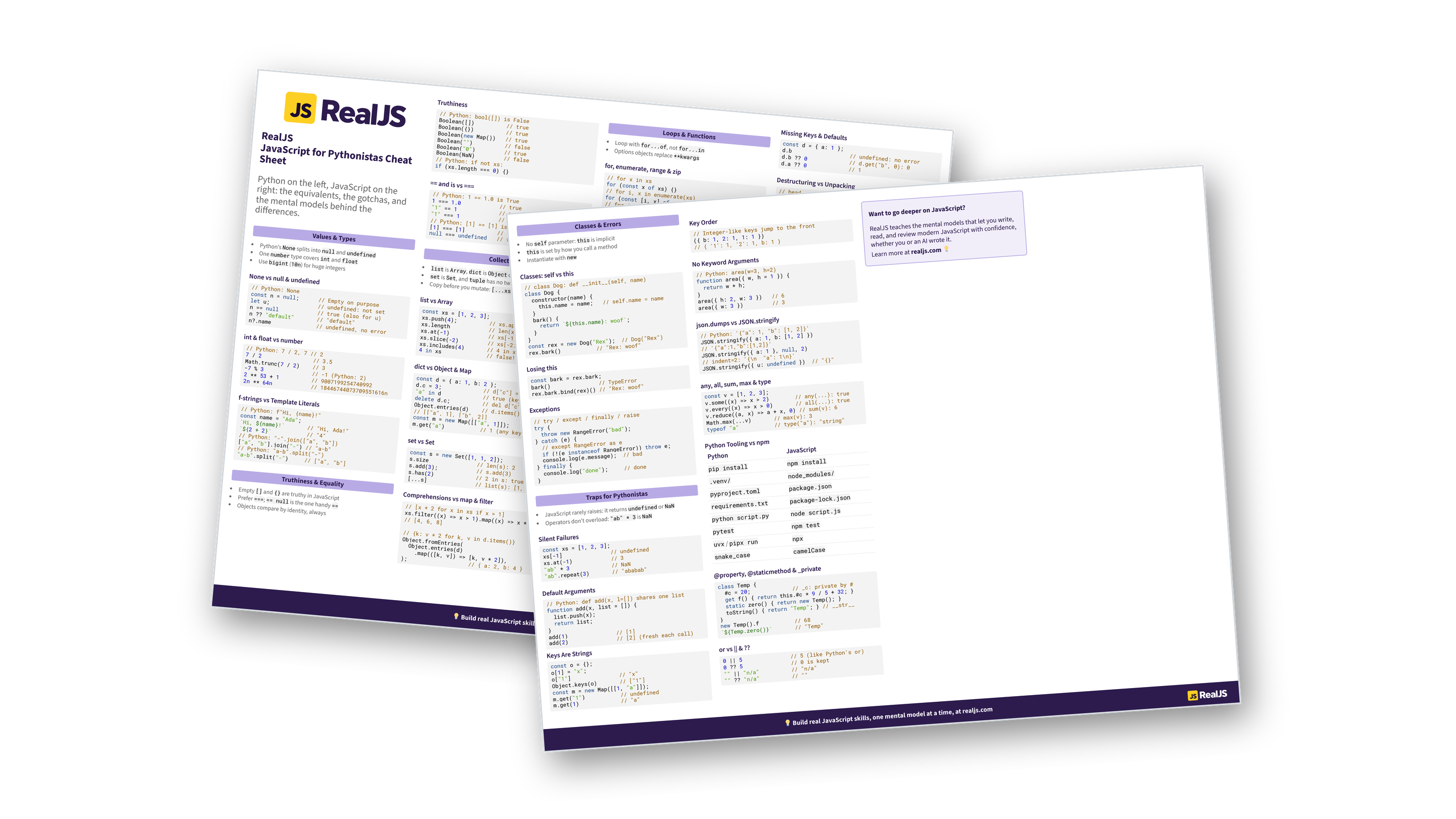
Already know Python? This cheat sheet maps what you know to modern JavaScript, side by side, so you can write, read, and review JavaScript with the right mental models. You can also download the information as a printable cheat sheet:
Free Bonus: JavaScript for Pythonistas Cheat Sheet
Get the JavaScript for Pythonistas Cheat Sheet (PDF), a printable reference to Python-to-JavaScript equivalents for None and null, numbers, f-strings, collections, truthiness, loops, classes, exceptions, async, modules, and common traps:
Want a guided path instead of a reference? Start learning at realjs.com.
Values & Types
- Python’s
Nonesplits intonullandundefined - One
numbertype coversintandfloat - Use
bigint(10n) for huge integers
None vs null & undefined
// Python: None
const n = null;      // Empty on purpose
let u;               // undefined: not set
n == null            // true (also for u)
n ?? "default"       // "default"
n?.name              // undefined, no error
int & float vs number
// Python: 7 / 2, 7 // 2
7 / 2                // 3.5
Math.trunc(7 / 2)    // 3
-7 % 3               // -1 (Python: 2)
2 ** 53 + 1          // 9007199254740992
2n ** 64n            // 18446744073709551616n
f-strings vs Template Literals
// Python: f"Hi, {name}!"
const name = "Ada";
`Hi, ${name}!`       // "Hi, Ada!"
`${2 + 2}`           // "4"
// Python: "-".join(["a", "b"])
["a", "b"].join("-") // "a-b"
// Python: "a-b".split("-")
"a-b".split("-")     // ["a", "b"]
Truthiness & Equality
- Empty
[]and{}are truthy in JavaScript - Prefer
===;== nullis the one handy== - Objects compare by identity, always
Truthiness
// Python: bool([]) is False
Boolean([])          // true
Boolean({})          // true
Boolean(new Map())   // true
Boolean("")          // false
Boolean("0")         // true
Boolean(NaN)         // false
// Python: if not xs:
if (xs.length === 0) {}
== and is vs ===
// Python: 1 == 1.0 is True
1 === 1.0            // true
"1" == 1             // true (avoid)
"1" === 1            // false
// Python: [1] == [1] is True
[1] === [1]          // false
null === undefined   // false
Collections
listisArray,dictisObjectorMapsetisSet, andtuplehas no twin- Copy before you mutate:
[...xs],{ ...d }
list vs Array
const xs = [1, 2, 3];
xs.push(4);          // xs.append(4)
xs.length            // len(xs): 4
xs.at(-1)            // xs[-1]: 4
xs.slice(-2)         // xs[-2:]: [3, 4]
xs.includes(4)       // 4 in xs: true
4 in xs              // false! Checks index
dict vs Object & Map
const d = { a: 1, b: 2 };
d.c = 3;             // d["c"] = 3
"a" in d             // true (key check)
delete d.c;          // del d["c"]
Object.entries(d)    // d.items()
// [["a", 1], ["b", 2]]
const m = new Map([["a", 1]]);
m.get("a")           // 1 (any key type)
set vs Set
const s = new Set([1, 1, 2]);
s.size               // len(s): 2
s.add(3);            // s.add(3)
s.has(2)             // 2 in s: true
[...s]               // list(s): [1, 2, 3]
Comprehensions vs map & filter
// [x * 2 for x in xs if x > 1]
xs.filter((x) => x > 1).map((x) => x * 2)
// [4, 6, 8]

// {k: v * 2 for k, v in d.items()}
Object.fromEntries(
  Object.entries(d)
    .map(([k, v]) => [k, v * 2]),
);                   // { a: 2, b: 4 }
Loops & Functions
- Loop with
for...of, notfor...in - Options objects replace
**kwargs
for, enumerate, range & zip
// for x in xs
for (const x of xs) {}
// for i, x in enumerate(xs)
for (const [i, x] of xs.entries()) {}
// for i in range(3)
for (let i = 0; i < 3; i++) {}
const ys = ["a", "b", "c"];
xs.map((x, i) => [x, ys[i]])
// like zip(), but pads with undefined
Array.from({ length: 3 }, (_, i) => i)
// list(range(3)): [0, 1, 2]
*args & **kwargs vs Rest & Spread
// def f(a, b=2, *args)
function f(a, b = 2, ...args) {
  return [a, b, args];
}
f(1)                 // [1, 2, []]
f(1, 5, 6, 7)        // [1, 5, [6, 7]]
f(...xs)             // [1, 2, [3, 4]]

// def g(*, x, y=0)
function g({ x, y = 0 }) {
  return x + y;
}
g({ x: 1 })          // 1
({ ...d, e: 5 })     // {**d, "e": 5}
Free Bonus: Download the JavaScript for Pythonistas Cheat Sheet PDF and keep the essentials at hand.
Strings, Numbers & Sorting
- Methods return new values; strings are immutable
sort()changes the array and compares as text- Use
toSorted()for Python’ssorted()
Strings
const s = " Hi, Ada ";
s.trim()             // s.strip(): "Hi, Ada"
s.includes("Ada")    // "Ada" in s: true
s.startsWith(" Hi")  // true
"ab".repeat(3)       // "ab" * 3: "ababab"
Sorting
const n = [3, 1, 2];
// sorted(n)
n.toSorted((a, b) => a - b) // [1, 2, 3]
// n.sort() sorts as text and mutates
[10, 9, 1].sort()    // [1, 10, 9]
Convert & Round
Number("42")         // int("42"): 42
Number("4x")         // NaN, not ValueError
String(42)           // str(42): "42"
(3.14159).toFixed(2) // round(x, 2): "3.14"
Math.round(2.5)      // 3 (Python: 2)
Missing Keys & Defaults
const d = { a: 1 };
d.b                  // undefined: no error
d.b ?? 0             // d.get("b", 0): 0
d.a ?? 0             // 1
Destructuring vs Unpacking
// head, *tail = [3, 1, 2]
const [head, ...tail] = [3, 1, 2];
// head is 3, tail is [1, 2]
const { a, z = 9 } = d;  // a is 1, z is 9
Generators
// def count(n): yield from range(n)
function* count(n) {
  for (let i = 0; i < n; i++) yield i;
}
[...count(3)]   // list(count(3)): [0, 1, 2]
Async, Modules & Tooling
- JavaScript has a built-in event loop: no
asyncio.run() - Promises start running as soon as you call them
asyncio vs async & await
// asyncio.gather(a(), b())
const [x, y] = await Promise.all([
  a(),
  b(),
]);                  // ["a", "b"]
// await asyncio.sleep(1)
await new Promise(
  (r) => setTimeout(r, 1000),
);
Imports & Exports
// from math import add
import { add } from "./math.js";
// import math
import * as math from "./math.js";
// Nothing is private by default; export it
export const PI = 3.14159;
print vs console.log
console.log("Total:", 42);  // print()
console.log(d);      // { a: 1, b: 2 }
console.error("Oops");      // To stderr
JSON.stringify(d)    // '{"a":1,"b":2}'
`${d}`               // "[object Object]"
Classes & Errors
- No
selfparameter:thisis implicit thisis set by how you call a method- Instantiate with
new
Classes: self vs this
// class Dog: def __init__(self, name)
class Dog {
  constructor(name) {
    this.name = name;   // self.name = name
  }
  bark() {
    return `${this.name}: woof`;
  }
}
const rex = new Dog("Rex");  // Dog("Rex")
rex.bark()           // "Rex: woof"
Losing this
const bark = rex.bark;
bark()               // TypeError
rex.bark.bind(rex)() // "Rex: woof"
Exceptions
// try / except / finally / raise
try {
  throw new RangeError("bad");
} catch (e) {
  // except RangeError as e
  if (!(e instanceof RangeError)) throw e;
  console.log(e.message);  // bad
} finally {
  console.log("done");     // done
}
Traps for Pythonistas
- JavaScript rarely raises: it returns
undefinedorNaN - Operators don’t overload:
"ab" * 3isNaN
Silent Failures
const xs = [1, 2, 3];
xs[-1]               // undefined
xs.at(-1)            // 3
"ab" * 3             // NaN
"ab".repeat(3)       // "ababab"
Default Arguments
// Python: def add(x, l=[]) shares one list
function add(x, list = []) {
  list.push(x);
  return list;
}
add(1)               // [1]
add(2)               // [2] (fresh each call)
Keys Are Strings
const o = {};
o[1] = "x";
o["1"]               // "x"
Object.keys(o)       // ["1"]
const m = new Map([[1, "a"]]);
m.get("1")           // undefined
m.get(1)             // "a"
Key Order
// Integer-like keys jump to the front
({ b: 1, 2: 1, 1: 1 })
// { '1': 1, '2': 1, b: 1 }
No Keyword Arguments
// Python: area(w=3, h=2)
function area({ w, h = 1 }) {
  return w * h;
}
area({ h: 2, w: 3 })   // 6
area({ w: 3 })         // 3
json.dumps vs JSON.stringify
// Python: '{"a": 1, "b": [1, 2]}'
JSON.stringify({ a: 1, b: [1, 2] })
// '{"a":1,"b":[1,2]}'
JSON.stringify({ a: 1 }, null, 2)
// indent=2: '{\n  "a": 1\n}'
JSON.stringify({ u: undefined })  // "{}"
any, all, sum, max & type
const v = [1, 2, 3];
v.some((x) => x > 2)        // any(...): true
v.every((x) => x > 0)       // all(...): true
v.reduce((a, x) => a + x, 0) // sum(v): 6
Math.max(...v)       // max(v): 3
typeof "a"           // type("a"): "string"
Python Tooling vs npm
| Python | JavaScript |
|---|---|
pip install |
npm install |
.venv/ |
node_modules/ |
pyproject.toml |
package.json |
requirements.txt |
package-lock.json |
python script.py |
node script.js |
pytest |
npm test |
uvx / pipx run |
npx |
snake_case |
camelCase |
@property, @staticmethod & _private
class Temp {
  #c = 20;             // _c: private by #
  get f() { return this.#c * 9 / 5 + 32; }
  static zero() { return new Temp(); }
  toString() { return "Temp"; } // __str__
}
new Temp().f           // 68
`${Temp.zero()}`       // "Temp"
or vs || & ??
0 || 5               // 5 (like Python's or)
0 ?? 5               // 0 is kept
"" || "n/a"          // "n/a"
"" ?? "n/a"          // ""
Want to go deeper on JavaScript?
RealJS teaches the mental models that let you write, read, and review modern JavaScript with confidence, whether you or an AI wrote it.
Learn more at realjs.com 💡
You can download this information as a printable cheat sheet:
Free Bonus: JavaScript for Pythonistas Cheat Sheet
Get the JavaScript for Pythonistas Cheat Sheet (PDF), a printable reference to Python-to-JavaScript equivalents for None and null, numbers, f-strings, collections, truthiness, loops, classes, exceptions, async, modules, and common traps:
