Array and Iterator Methods Cheat Sheet
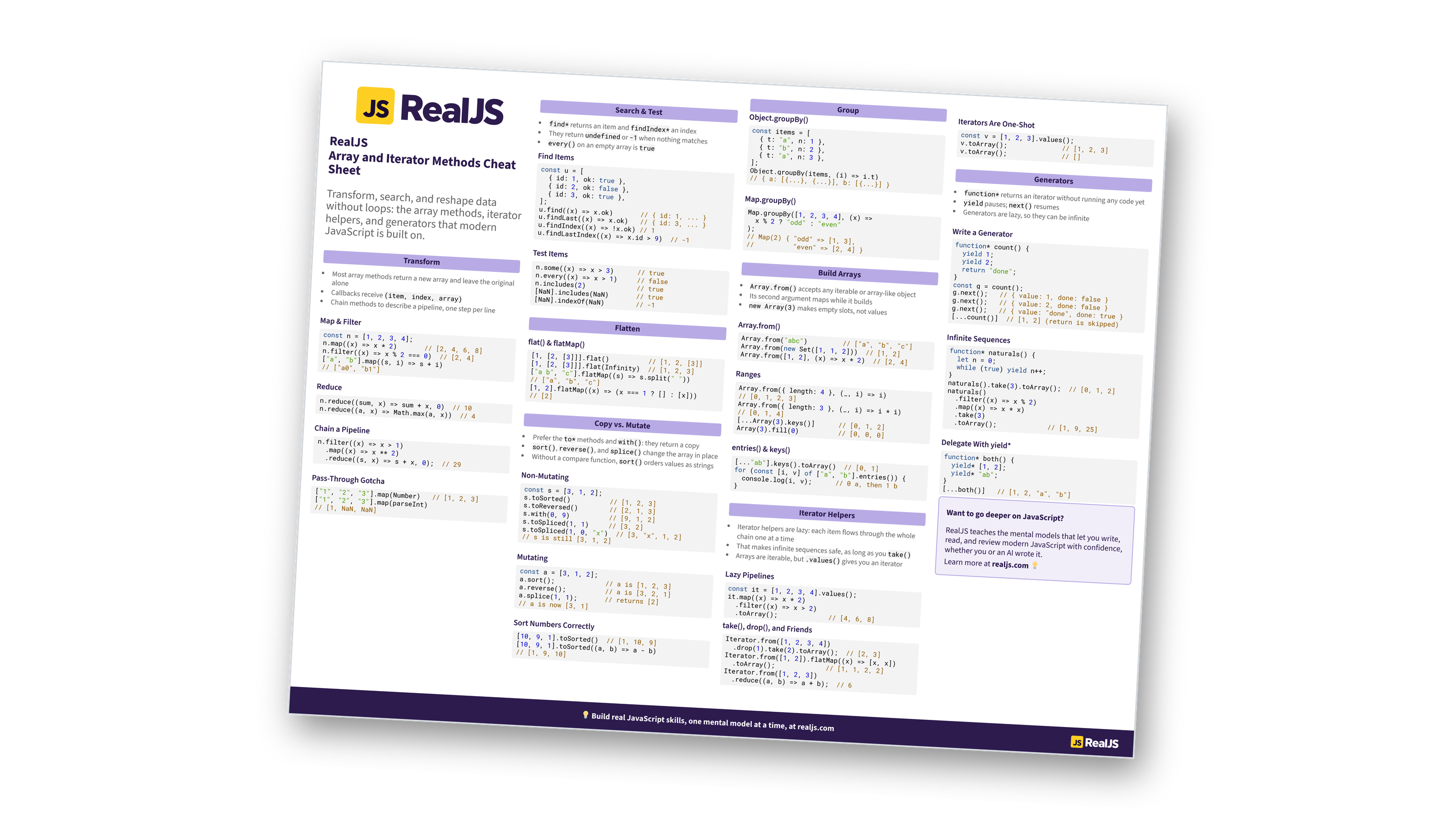
Transform, search, and reshape data without loops. Learn the mental models behind map, filter, reduce, iterator helpers, and generators so you can write, read, and review modern JavaScript, whether you or an AI wrote it. You can also download the information as a printable cheat sheet:
Free Bonus: Array and Iterator Methods Cheat Sheet
Get the Array and Iterator Methods Cheat Sheet (PDF), a printable reference to map, filter, reduce, find, some, every, flat, non-mutating methods like toSorted and with, Object.groupBy, Array.from ranges, iterator helpers, and generators:
Want a guided path instead of a reference? Start learning at realjs.com.
Transform
- Most array methods return a new array and leave the original alone
- Callbacks receive
(item, index, array) - Chain methods to describe a pipeline, one step per line
Map & Filter
const n = [1, 2, 3, 4];
n.map((x) => x * 2)       // [2, 4, 6, 8]
n.filter((x) => x % 2 === 0)  // [2, 4]
["a", "b"].map((s, i) => s + i)
// ["a0", "b1"]
Reduce
n.reduce((sum, x) => sum + x, 0)  // 10
n.reduce((a, x) => Math.max(a, x))  // 4
Chain a Pipeline
n.filter((x) => x > 1)
  .map((x) => x ** 2)
  .reduce((s, x) => s + x, 0);  // 29
Pass-Through Gotcha
["1", "2", "3"].map(Number)   // [1, 2, 3]
["1", "2", "3"].map(parseInt)
// [1, NaN, NaN]
Search & Test
find*returns an item andfindIndex*an index- They return
undefinedor-1when nothing matches every()on an empty array istrue
Find Items
const u = [
  { id: 1, ok: true },
  { id: 2, ok: false },
  { id: 3, ok: true },
];
u.find((x) => x.ok)       // { id: 1, ... }
u.findLast((x) => x.ok)   // { id: 3, ... }
u.findIndex((x) => !x.ok) // 1
u.findLastIndex((x) => x.id > 9)  // -1
Test Items
n.some((x) => x > 3)      // true
n.every((x) => x > 1)     // false
n.includes(2)             // true
[NaN].includes(NaN)       // true
[NaN].indexOf(NaN)        // -1
Flatten
flat() & flatMap()
[1, [2, [3]]].flat()          // [1, 2, [3]]
[1, [2, [3]]].flat(Infinity)  // [1, 2, 3]
["a b", "c"].flatMap((s) => s.split(" "))
// ["a", "b", "c"]
[1, 2].flatMap((x) => (x === 1 ? [] : [x]))
// [2]
Copy vs. Mutate
- Prefer the
to*methods andwith(): they return a copy sort(),reverse(), andsplice()change the array in place- Without a compare function,
sort()orders values as strings
Non-Mutating
const s = [3, 1, 2];
s.toSorted()          // [1, 2, 3]
s.toReversed()        // [2, 1, 3]
s.with(0, 9)          // [9, 1, 2]
s.toSpliced(1, 1)     // [3, 2]
s.toSpliced(1, 0, "x")  // [3, "x", 1, 2]
// s is still [3, 1, 2]
Mutating
const a = [3, 1, 2];
a.sort();             // a is [1, 2, 3]
a.reverse();          // a is [3, 2, 1]
a.splice(1, 1);       // returns [2]
// a is now [3, 1]
Sort Numbers Correctly
[10, 9, 1].toSorted()  // [1, 10, 9]
[10, 9, 1].toSorted((a, b) => a - b)
// [1, 9, 10]
Free Bonus: Download the Array and Iterator Methods Cheat Sheet PDF and keep the essentials at hand.
Group
Object.groupBy()
const items = [
  { t: "a", n: 1 },
  { t: "b", n: 2 },
  { t: "a", n: 3 },
];
Object.groupBy(items, (i) => i.t)
// { a: [{...}, {...}], b: [{...}] }
Map.groupBy()
Map.groupBy([1, 2, 3, 4], (x) =>
  x % 2 ? "odd" : "even"
);
// Map(2) { "odd" => [1, 3],
//          "even" => [2, 4] }
Build Arrays
Array.from()accepts any iterable or array-like object- Its second argument maps while it builds
new Array(3)makes empty slots, not values
Array.from()
Array.from("abc")         // ["a", "b", "c"]
Array.from(new Set([1, 1, 2]))  // [1, 2]
Array.from([1, 2], (x) => x * 2)  // [2, 4]
Ranges
Array.from({ length: 4 }, (_, i) => i)
// [0, 1, 2, 3]
Array.from({ length: 3 }, (_, i) => i * i)
// [0, 1, 4]
[...Array(3).keys()]      // [0, 1, 2]
Array(3).fill(0)          // [0, 0, 0]
entries() & keys()
[..."ab"].keys().toArray()  // [0, 1]
for (const [i, v] of ["a", "b"].entries()) {
  console.log(i, v);      // 0 a, then 1 b
}
Iterator Helpers
- Iterator helpers are lazy: each item flows through the whole chain one at a time
- That makes infinite sequences safe, as long as you
take() - Arrays are iterable, but
.values()gives you an iterator
Lazy Pipelines
const it = [1, 2, 3, 4].values();
it.map((x) => x * 2)
  .filter((x) => x > 2)
  .toArray();             // [4, 6, 8]
take(), drop(), and Friends
Iterator.from([1, 2, 3, 4])
  .drop(1).take(2).toArray();  // [2, 3]
Iterator.from([1, 2]).flatMap((x) => [x, x])
  .toArray();             // [1, 1, 2, 2]
Iterator.from([1, 2, 3])
  .reduce((a, b) => a + b);  // 6
Iterators Are One-Shot
const v = [1, 2, 3].values();
v.toArray();              // [1, 2, 3]
v.toArray();              // []
Generators
function*returns an iterator without running any code yetyieldpauses;next()resumes- Generators are lazy, so they can be infinite
Write a Generator
function* count() {
  yield 1;
  yield 2;
  return "done";
}
const g = count();
g.next();   // { value: 1, done: false }
g.next();   // { value: 2, done: false }
g.next();   // { value: "done", done: true }
[...count()]  // [1, 2] (return is skipped)
Infinite Sequences
function* naturals() {
  let n = 0;
  while (true) yield n++;
}
naturals().take(3).toArray();  // [0, 1, 2]
naturals()
  .filter((x) => x % 2)
  .map((x) => x * x)
  .take(3)
  .toArray();             // [1, 9, 25]
Delegate With yield*
function* both() {
  yield* [1, 2];
  yield* "ab";
}
[...both()]   // [1, 2, "a", "b"]
Want to go deeper on JavaScript?
RealJS teaches the mental models that let you write, read, and review modern JavaScript with confidence, whether you or an AI wrote it.
Learn more at realjs.com 💡
You can download this information as a printable cheat sheet:
Free Bonus: Array and Iterator Methods Cheat Sheet
Get the Array and Iterator Methods Cheat Sheet (PDF), a printable reference to map, filter, reduce, find, some, every, flat, non-mutating methods like toSorted and with, Object.groupBy, Array.from ranges, iterator helpers, and generators:
